
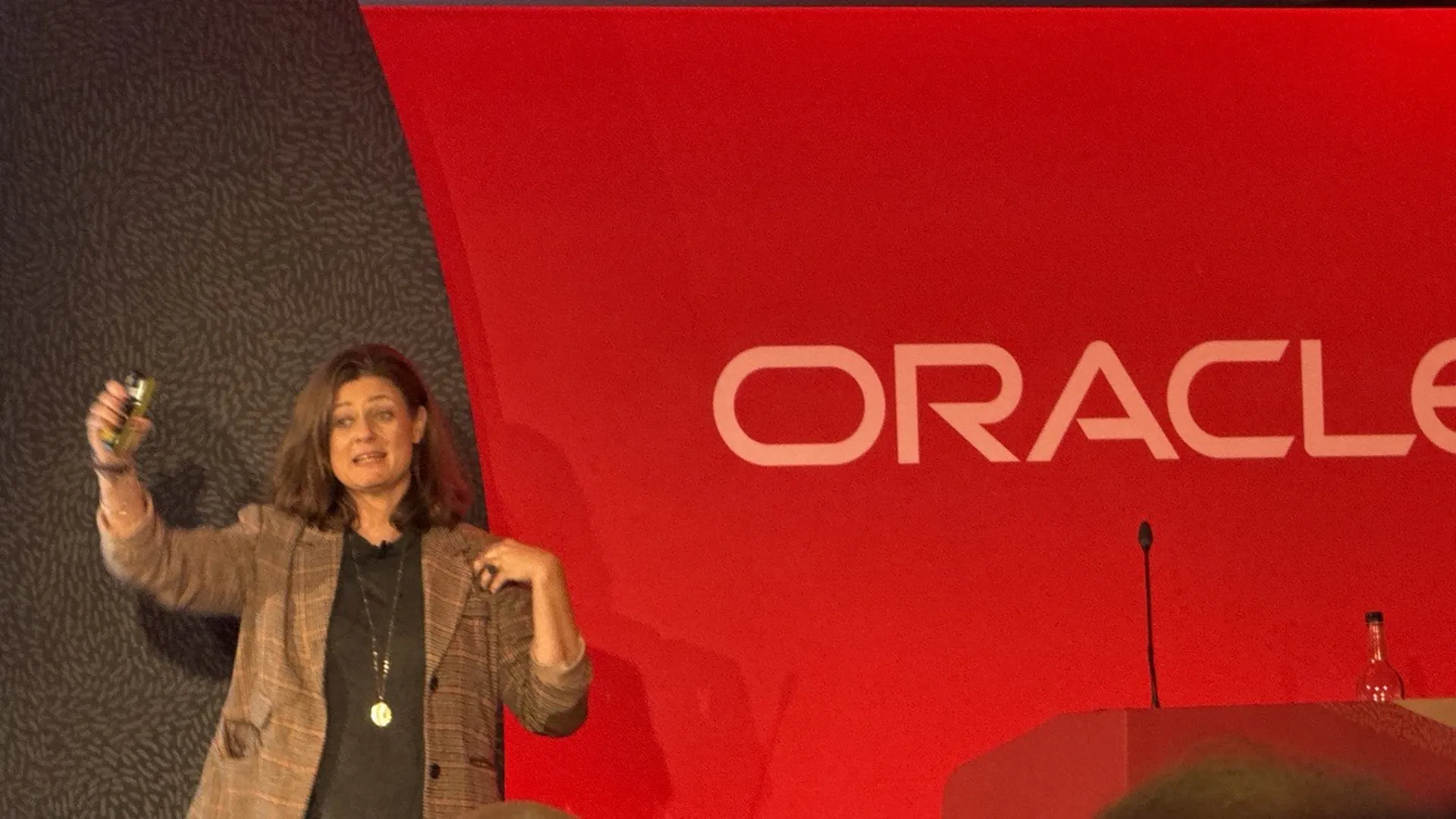
Financial services has spent 20 to 25 years treating modernisation as a project with an end date. Opening the Oracle Financial Services Summit in London, Dr. Leda Glyptis argued that the industry's weaker record is the buildup of exceptions, and that AI will arrive on top of that buildup rather than replace it.
Executive Summary
- Modernisation decisions reduce risk and improve future competitiveness, yet the same decisions alter risk profiles and can make operations more complex.
- New capabilities are layered onto older ones rather than replacing them, a pattern Dr. Glyptis says has held since 1950. She has switched something off only twice in 25 years.
- When a policy blocks an initiative, the one-time exception is common, changing the process first is rarely seen, and the exception turns into precedent.
- A $180-per-meeting headset request shows how approval chains lose context at each layer. The approval process likely cost the bank far more than the headset.
- AI can accelerate the work but does not supply all the answers. Leaders should expect neither a settled regulatory framework nor a finished technology.
- The foundations are boring and essential: an evolution strategy, good data, and a way to be both sturdy and agile in a real-time world.
Most technology programmes in financial services begin with a promise that this time the complexity will go down. Dr. Glyptis's argument is that the promise has been made for a generation and that it has mostly gone unkept. Teams have spent 20 to 25 years on this work, yet the number of challenges keeps growing. If effort alone fixed the problem, it would have shrunk by now.
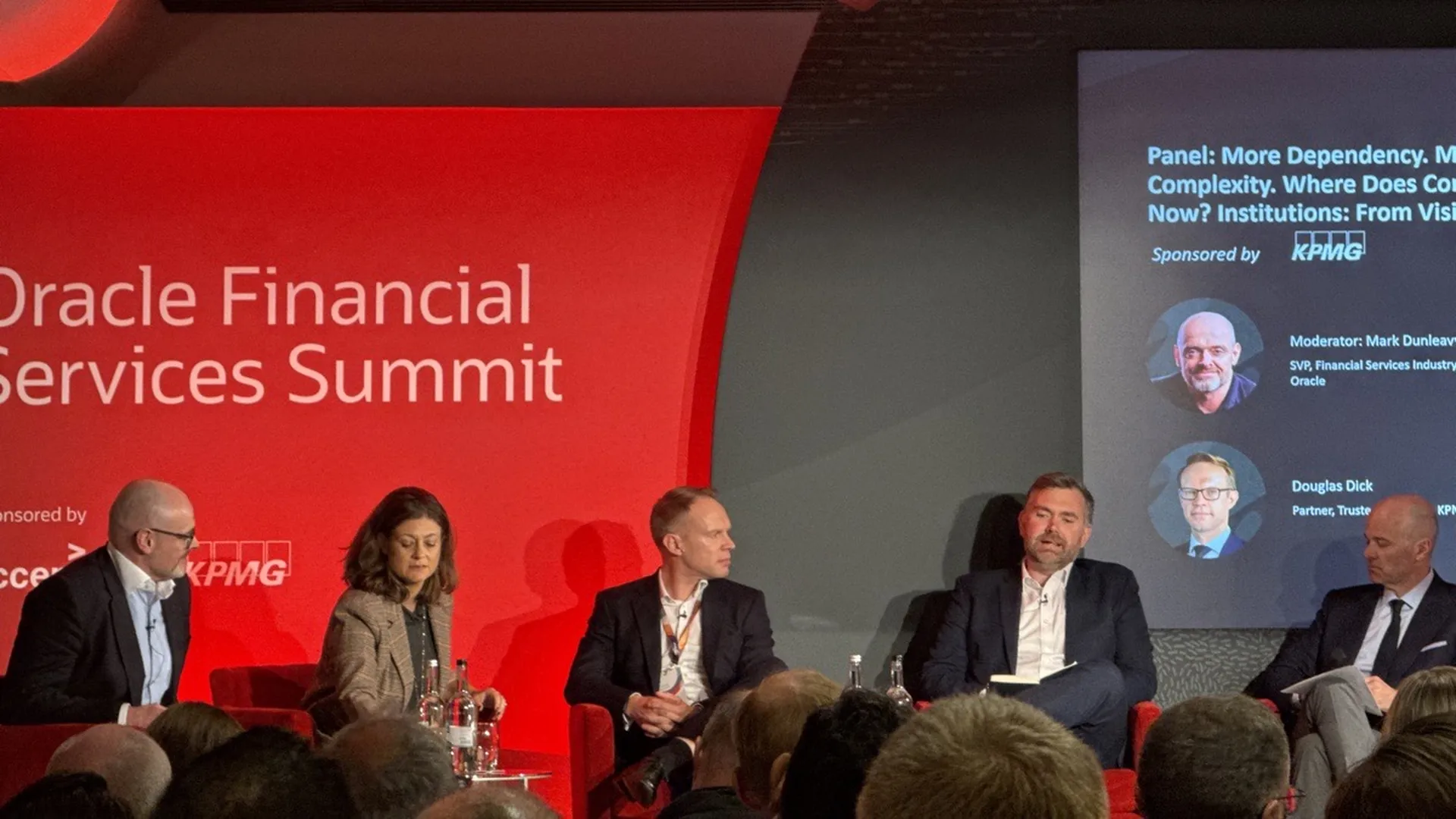
Dr. Glyptis hosted the Oracle Financial Services Summit in London on 20 October 2026 and opened its session on AI, business modernisation, resilience and trust. As host, she set out three connected priorities that, she said, come up consistently in Oracle's customer conversations: bringing AI into core operations with measurable business impact, modernising while keeping pace with rapid technology change, and preserving resilience and trust. Oracle's role was described as providing the secure, scalable systems that underpin customers' businesses. She thanked Accenture and KPMG for their partnership with Oracle globally and in the UK and Ireland, and explained that the day was built around questions, speakers, panels, breakout rooms and direct conversations with Oracle staff. Her own keynote, though, was less a product pitch than a diagnosis.

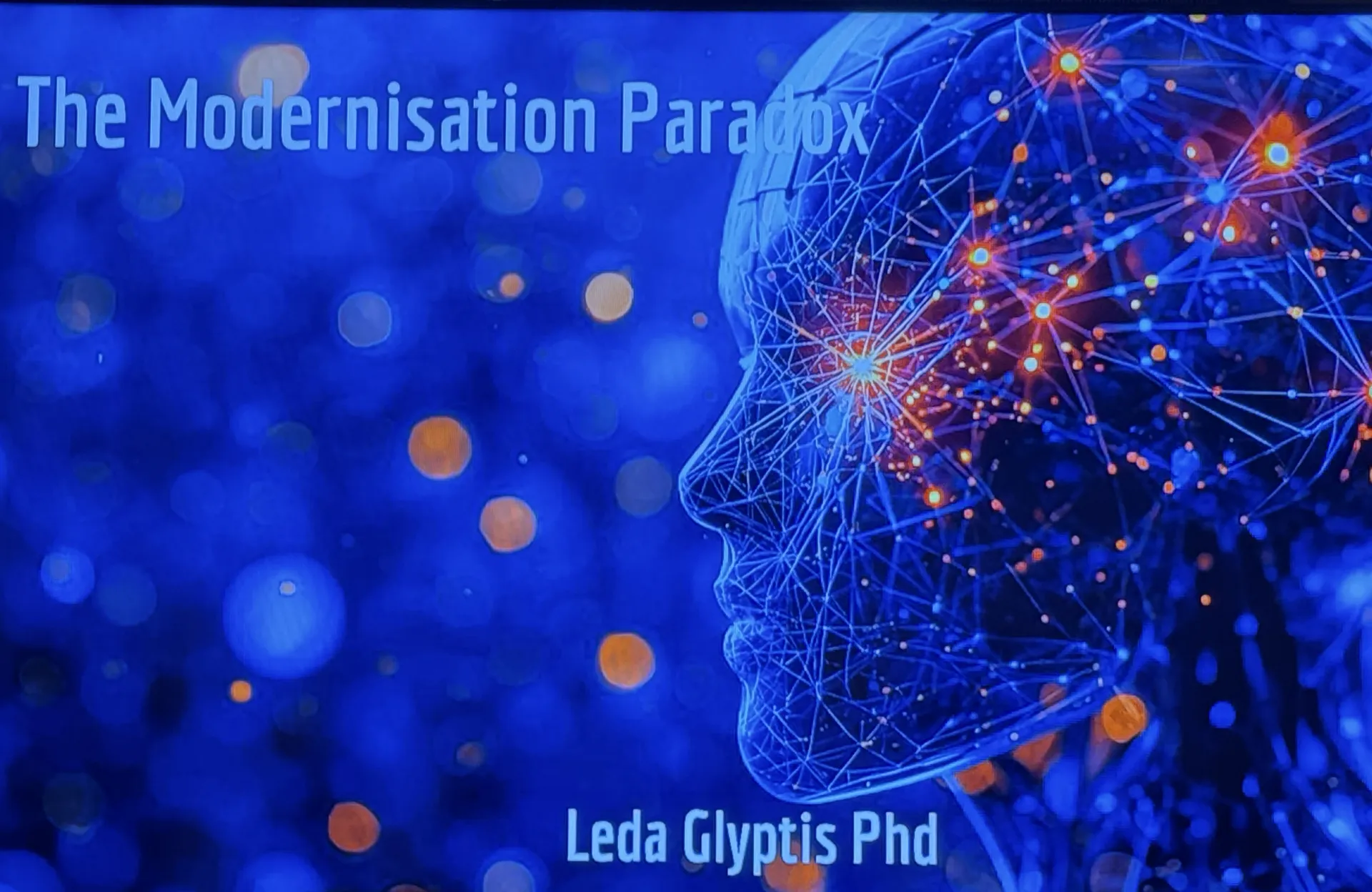
Her central instruction was blunt. Financial-services leaders must stop treating modernisation as a finite programme and address the accumulated complexity created by decades of exceptions. The rest of her argument follows from that sentence, and this article does too.
A finish line that keeps moving #
The usual story of modernisation has a before and an after. A platform is replaced, a migration completes, a steering committee closes the programme. Dr. Glyptis rejects the "after". Modernisation, she says, is not an end state. Projects may finish, but organisations do not become permanently "modern".
That sounds like semantics until you consider what organisations are actually doing when they decide to modernise. They act to reduce risk and to improve their future competitiveness. Those are sensible aims. But the same decisions also alter risk profiles and can make operations more complex. The move that lowers one risk can introduce another, and the new arrangement has to be run, funded and explained to someone.
The pattern is a trap in the literal sense. A leader who believes the programme will end plans for the end. A leader who accepts it won't plans for continuity, and that changes budgets, governance and the way success is measured. The first leader keeps being surprised. The second might at least be prepared.
There is also a plain explanation for why simplification has so often failed to arrive. Modernisation was meant to simplify but has often made life more complicated, because organisations could not foresee how complex the external environment would become. That isn't an accusation of poor engineering. The plans were reasonable, and the environment outran them.
A B minus and two switch-offs #
Dr. Glyptis gave the industry a B minus for the past 25 years. It's a useful grade because it refuses both comfort and despair. A B minus is not a fail. It also isn't what anyone would hope for after a quarter of a century of sustained effort.
She added a figure that makes the grade easier to understand: she has switched something off only twice in 25 years. Consider what that implies for a working architecture. If systems, processes and controls are almost never retired, then every new thing adds to the total. Nothing leaves.
This links directly to her claim that new capabilities are layered onto older ones rather than replacing them, and that this pattern has been in place since 1950. The industry's habit isn't a recent failing of the cloud era or the app era. By her account it is older than most of the people now trying to manage it.
Layering has its own logic. Adding is safer than removing, and removing needs someone to own the consequences. But the cost is cumulative. Each layer must coexist with the ones beneath it, and each carries its own assumptions about data, access and approval. After seventy-odd years, the interactions among them are the real subject of modernisation work.
The B minus sits oddly beside another statement of hers: the industry has been preparing for this moment for 25 years. Read together, the two lines say that the preparation was real and the results were partial. She also argued that established institutions have adapted more successfully than they often acknowledge. That claim should be held with care, since it's a view she argued rather than a measured result. But it fits the grade. An industry can adapt better than it admits and still carry a damaging backlog of unretired exceptions.
How a one-off becomes the rule #
The most useful part of Dr. Glyptis's argument is her account of what happens when a policy or process blocks an initiative. She described three practical choices. Do not do the initiative. Change the process first. Or use a one-time workaround, risk acceptance, or senior-sponsored exception.
The first option is rarely attractive, because someone wanted the initiative for a reason. The second is the one that would actually reduce complexity, because it fixes the barrier itself. She said she has rarely seen it happen. The third is common.
The mechanism after that is where the damage accrues. Organisations sometimes return to fix the process. More often the exception is forgotten. It becomes a precedent by default, and when the same barrier appears again, another exception is made.
Walk through that sequence slowly, because it's the engine of the whole problem. An exception is granted for a legitimate reason, under time pressure, by someone senior enough to sign it. Nobody schedules the repair. The next team meets the same obstacle, finds that the first team got through, and cites the earlier case. The workaround has become a route. Because each exception was individually reasonable, no one ever decided to build a system that runs on them.
This is what she means by the accumulated complexity of decades of exceptions. The phrase carries a specific thing: the stock of unresolved decisions that were each made to keep work moving. It also explains why financial services' weaker record is the buildup of exceptions. The industry is not short of ways to get things done. It is short of ways to stop getting them done the same awkward way.
The practical consequence for a leader is uncomfortable. Granting the exception feels like decisiveness. Under this account, decisiveness without a follow-up to fix the process is how complexity compounds. The test of a sponsor isn't whether they can clear a barrier once, but whether the barrier is still there the next time.
The $180 headset #
Dr. Glyptis made the point concrete with a small story. In an earlier role as a senior director, she could sign contracts worth about $50,000. A request for a headset, which cost $180 per meeting, was approved by an executive in about 24 hours.
Twenty-four hours sounds fast, and in isolation it is. The point lies in what the process surrounding the request probably consumed. Her view, stated with appropriate hedging, was that the approval process likely cost the bank far more than the headset. The arithmetic of a $180 item set against the time of the people who touched the request is not in her favour, and it never is in anyone's.
The structural problem is in how escalation works. In the traditional chain, each layer loses context. A request that made obvious sense where it started arrives at the top as a summary of a summary. Each person in between must either re-learn the situation or pass it up unexamined. Alignment in that process can take months.
Set the two numbers side by side: about 24 hours for the headset, and months for alignment through a traditional escalation. They aren't measuring the same thing, but together they show a spread. A small, clear request with the right person can move in a day. A matter that has to travel through layers, each stripping context as it goes, can stall for months.
And the habit has not gone away. Organisations still require senior approval for minor spending. That isn't a story about one bank from a former job. It is a current limitation, and it feeds the exception problem above. When ordinary decisions must climb a chain, people look for the exception route, because the chain is expensive and the exception is quick. Legacy is not just old technology. It also lives in the rules about who may decide what.
Twenty pilots, all of them urgent #
If exceptions are the disease, prioritisation is where the symptoms show first. Dr. Glyptis said many organisations she works with have about 20 pilot projects, all treated as equally important. She called that insufficient prioritisation.
The logic is easy to follow. If everything is equally important, nothing is ranked, and the ranking is made implicitly by whoever shouts, signs or escalates. That is precisely the route by which the exception thrives. Twenty equal priorities guarantee that barriers will appear in several places at once, and that someone will be asked to wave a few of them through.
She framed prioritisation as now a leadership problem, because change programmes were rarely designed to be repeatable. This is a careful claim and worth reading closely. It doesn't say leaders are failing at a task they were handed. It says the task changed. When a change programme is a one-off, you can survive with a loose ordering of work. When change is continuous, the ordering has to be something leaders do again and again, and the programmes weren't built for that.
For founders and technical readers, this is the part that translates most easily. A portfolio of 20 pilots reads like energy. By this account, it more often signals that nobody has yet chosen. The decision to say no to nineteen of them is a leadership act, and it can't be delegated to a project office that has no authority to refuse.
AI arrives on a fixed timetable of its own #
Everything above gets sharper with AI, because AI changes the pace without changing the underlying habits. Dr. Glyptis said AI can help accelerate the work but does not supply all the answers. It is a useful accelerator. It isn't a substitute for deciding what to fix.
She was especially direct on one approach. The idea of simply "pointing AI" at problems she called a terrible idea. The reasoning follows from her earlier points: an organisation whose problems include unretired exceptions, siloed data and unclear ownership will not find those resolved by aiming a new tool at them. The tool inherits the mess.
She also described how organisations misjudge novelty. They often behave as though a technology is new to the world simply because it is new to them. And they may assume the technology will stop evolving once they are ready to engage. It will not.
Her account of 2024 shows both sides of this. The surge of AI activity that year brought creativity and empowerment. It also brought surprises. Some firms were surprised to find that vendors were already 10 years old. Others were surprised that AI itself was decades old and still evolving. The surprise was about the firms' awareness rather than the technology's age.
There is a parallel in a story she told about 2009. A CEO asked her then whether he needed to learn about Bitcoin before retiring. The question assumed that a technology decision could be deferred past one's own tenure. Her observation now is the opposite: today's technology decisions will often play out during the current decision maker's tenure. The retirement horizon no longer protects anyone.
The environment around those decisions is unsettled, too. AI is moving faster than many standards, controls and shared understandings. Leaders cannot assume technology decisions will arrive with a settled regulatory framework or a finished technology. Waiting for both is a plan that never reaches its trigger.
Calm, and not slow #
Faced with that, her prescription is two-sided. What organisations need is calm, not panic. Her advice was to be safe, measured and cautious, but not slow.
It would be easy to read this as a compromise, but it works better as a constraint on both failure modes. Panic produces the 20 equal pilots and the signed-off exceptions. Slowness produces the assumption that the technology will wait. She rejects each. The posture she describes is one where the pace is steady, the controls are present, and the work still moves.
That is also where the claim that the industry has been preparing for 25 years matters. Preparation, in her telling, is not a reason to relax. It is the reason calm is available: the sector has done a quarter-century of this work, and has learned something from it, even if the grade was a B minus.
The boring foundations #
Dr. Glyptis did not end on a vision. She named foundations that are, in her words, boring and essential, and the first is an evolution strategy. The reason is simple: no technology component or partner lasts forever. A strategy that assumes permanence is a strategy for the next surprise.
The second is good data. Data quality, ownership and siloed structures remain unresolved legacy issues. This sits right alongside her statement that legacy is not just old technology. Unclear ownership of a dataset is legacy. So is a rule that sends a minor purchase to a senior approver. Neither shows up on an asset register of old systems.
The third part of her case concerns the shape of the world these foundations must carry. The world is becoming real-time, and organisations must build robustness for that reality. She added that robustness and agility are no longer a trade-off. For years, the sturdy option and the agile option were treated as rivals, and the sturdy one usually won inside a regulated institution. Her claim is that the choice no longer has to be made, because a real-time world demands both at once.
One more observation points to movement. Financial-services firms, particularly insurers, are increasingly bringing partners into more open conversations about their plans and approaches. That fits the logic of an evolution strategy, since a partner that won't last forever is easier to plan around when it knows what is coming. It doesn't prove the exceptions are shrinking, and nothing in the source says it does. But it is a sign that firms are willing to talk about the problem openly.
What retiring an exception would take #
Return to the number that stands out most: two switch-offs in 25 years. If that rate is anything like typical, the industry's challenge is not building the next capability but deciding what the next capability will replace. Every other argument here depends on that. Exceptions can only be repaid if someone owns the repair, and layers can only be reduced if someone is willing to switch one off.
The open question the argument leaves is a practical one. A leader who accepts that modernisation never finishes still has to decide which single exception to close first, and which of 20 pilots to stop. Dr. Glyptis offers the framing, the grade and the three choices, but she doesn't claim to have measured how often the second choice, changing the process first, could replace the third. She has rarely seen it. Whether that changes in an AI-accelerated decade, when decisions play out within a single tenure, is the thing worth watching.
Frequently Asked Questions #
What is the modernisation paradox Dr. Glyptis described? Organisations make modernisation decisions to reduce risk and improve future competitiveness, but the same decisions also alter risk profiles and can make operations more complex. Modernisation was meant to simplify and has often made life more complicated, because organisations could not foresee how complex the external environment would become.
Why does she say modernisation is not an end state? Projects may finish, but organisations do not become permanently "modern". Teams have spent 20 to 25 years on this work, yet the number of challenges keeps growing, and new capabilities are layered onto older ones rather than replacing them. She said she has switched something off only twice in 25 years.
How do exceptions turn into the operating model? When a policy or process blocks an initiative, there are three choices: do not do the initiative, change the process first, or use a one-time workaround, risk acceptance or senior-sponsored exception. She has rarely seen the second happen; the third is common. The exception is usually forgotten and becomes a precedent by default.
What did she advise leaders to do about AI? To be safe, measured and cautious, but not slow. She called simply "pointing AI" at problems a terrible idea, said organisations need calm rather than panic, and warned that leaders cannot assume a settled regulatory framework or a finished technology.
Which foundations did she call boring and essential? An evolution strategy, because no technology component or partner lasts forever; tools and operating capability that can support the pace of change; partners that match the organisation's pace; good data, since quality, ownership and silos remain unresolved legacy issues; and repeatable processes that stop sending minor spending to senior approval.
References #
- Glyptis, L., (2026). The Modernisation Paradox in Financial Services. Keynote at the Oracle Financial Services Summit, London, 20 October 2026. Oracle Financial Services ⧉. Oracle.
- Glyptis, L., (2023). Bankers Like Us: Dispatches from an Industry in Transition ⧉. Routledge.
- Glyptis, L., (2026). #LedaWrites column archive ⧉. 11:FS.
Last reviewed .