
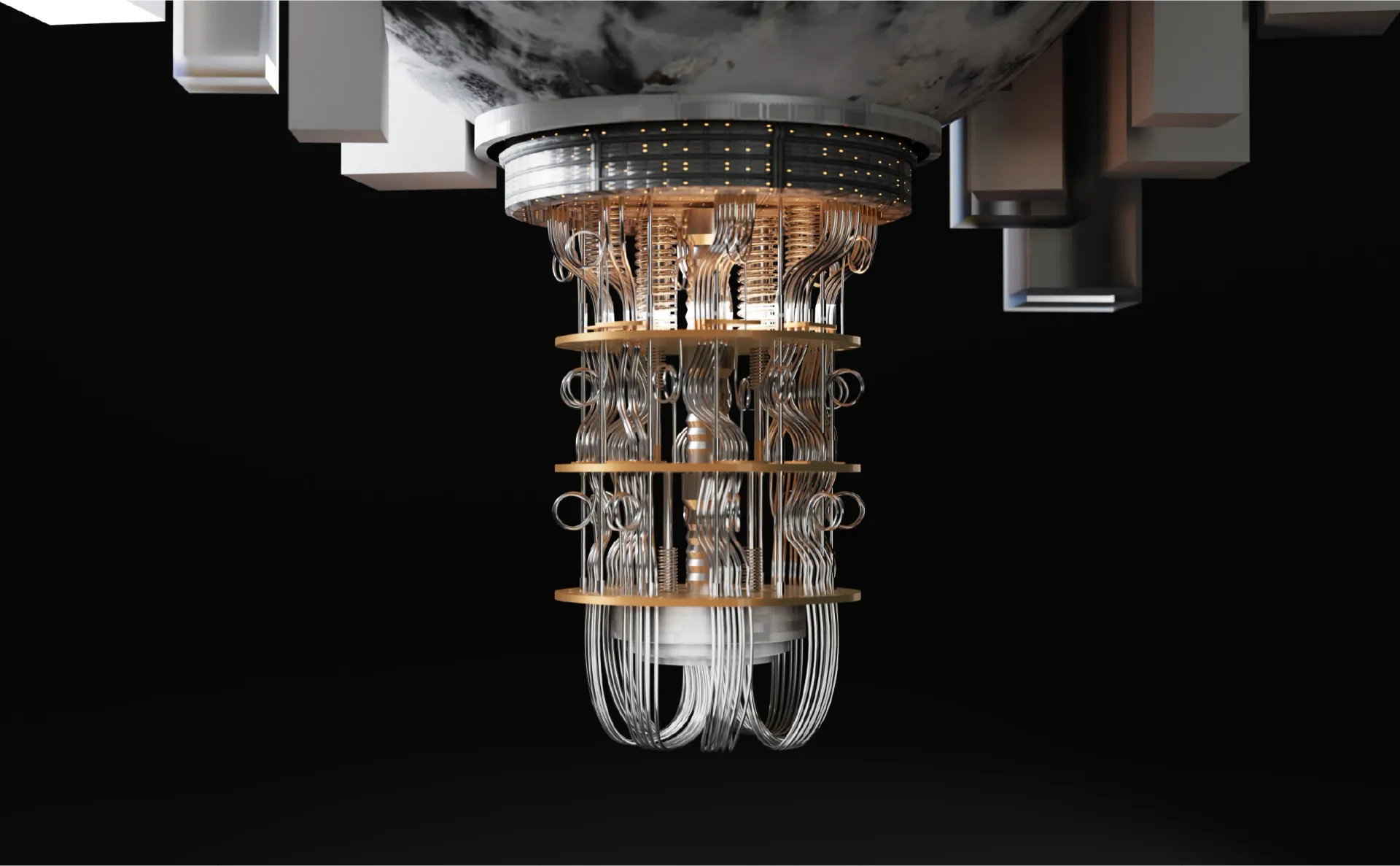
Executive Summary. The migration of bank cryptography to post-quantum primitives has stopped being a roadmap slide and become a dated obligation. Two instruments did the work. Executive Order 14409, signed 22 June 2026, puts hard dates on US federal and contractor migration. ANSSI closes the European certification window from 2027. Neither leaves a board the option of treating PQC as a research line item. This piece converts that pressure into a measurable index — five layers, each scored 0–5, weighted into a single composite a board can track quarterly and defend to a supervisor.
A year ago a bank could name FIPS 203 in a security review and call that a quantum strategy. EO 14409 and ANSSI changed the question from which algorithm to which rails, by which date, signed by whom. The index below is the instrument that answers it — built to put technical primitives, fiduciary liability and balance-sheet risk on the same page.
01. The Quantum Threat to Global Ledger Integrity #
Quantum computers threaten the mathematical foundation of modern digital security. RSA and ECC — the algorithms protecting banking transactions — rest on problems Shor's algorithm collapses in seconds once sufficient quantum scale arrives. The financial system's exposure is not uniform; it concentrates where confidentiality tails are longest and signed instructions live longest.
- SWIFT and interbank clearing. Session interception and non-repudiation failure are the acute risks. A forged or replayable settlement instruction is a balance-sheet event, not a logging incident.
- Depository registries. Compromised signature mechanisms could permit unauthorised ledger injections — the integrity failure that underwrites every downstream reconciliation.
- Store Now, Decrypt Later (SNDL). Financial telemetry is being harvested today for future decryption. This is why transport-layer encryption migrates first: the data already in transit is the data already at risk.
The five-year planning horizon for a CRQC is the working assumption inside Tier-1 banks. SNDL means adversaries do not need that machine today — they need cheap storage and patience. For a 25-year custody or trade-finance retention obligation, the exposure window has already opened.
02. The 2026 Post-Quantum Banking Resilience Index #
The index structures the transition into five measurable, auditable layers. Each is scored 0–5; the weighted total is the Composite Post-Quantum Resilience Score, tracked quarterly and reported to the board.
Table 1: Resilience Index Architecture #
| Index Layer | Readiness Metric | Failure Mode | Weight |
|---|---|---|---|
| Inventory & Discovery | % of apps with automated SBOM/CBOM | Undiscovered legacy keys | 30% |
| KEM / Transport | % of channels using hybrid ML-KEM | Retroactive decryption (SNDL) | 25% |
| Digital Signatures | % of pipelines with ML-DSA support | Forged ledger authorisations | 20% |
| Crypto-Agility | Mean time to swap crypto-primitives | Locked into vulnerable algorithms | 15% |
| Regulatory Alignment | Audit readiness; board sign-off | DORA supervisory findings | 10% |
The weighting is deliberate. Inventory dominates at 30% because every other layer is unmeasurable without it — you cannot migrate a key you have not found. Transport sits at 25% because SNDL makes it the only layer where the clock is already running against data captured today.
Table 2: Key Cryptographic Standards (NIST/FIPS) #
| Standard | Primitive | Primary Role |
|---|---|---|
| ML-KEM (FIPS 203) | Lattice-based KEM | Transport security (TLS 1.3) |
| ML-DSA (FIPS 204) | Lattice-based signature | Identity & transaction signing |
| SLH-DSA (FIPS 205) | Stateless hash signature | Long-term root certificates |
These three NIST PQC standards are the spine of every credible 2026 migration plan. The lattice pair carries day-to-day transport and signing; SLH-DSA's conservative hash-based construction earns its place at the root of trust, where a single cryptanalytic surprise is least tolerable.
03. Boardroom Playbook: 24-Month Roadmap #
The index measures where a bank stands. The roadmap sets the order of work. Each milestone produces a board-level deliverable, not a status update.
| Timeline | Focus Area | Board-Level Deliverable |
|---|---|---|
| 0–6 Mo | Discovery | Complete enterprise CBOM; identify high-sensitivity data lifecycles. |
| 6–12 Mo | Pilot | Deploy hybrid ML-KEM + ECDH for internet-facing transport. |
| 12–18 Mo | Integration | Migrate signing pipelines to ML-DSA; update HSM firmware. |
| 18–24 Mo | Optimisation | Integrate resilience scoring into Basel III / DORA dashboards. |
The sequence is not arbitrary. Discovery first, because the index's heaviest layer is also its prerequisite. Pilot on internet-facing transport, because that is the SNDL front line and the lowest-coordination surface to change. HSM firmware lands in the integration phase because the production crypto path runs through commercial modules — the migration slips the moment a single vendor's PQC firmware track does.
04. Platform Engineering: Bounded Hybrid Architectures #
To avoid the risk of unvetted PQC code, banks are adopting bounded hybrid cryptographic architectures. The approach wraps a classical ECDH share inside a NIST-standardised ML-KEM envelope, so the channel stays secure even if one algorithm is later broken. The bank is not betting on a single primitive surviving cryptanalysis for 25 years; it runs both, logs everything, and retains the option to drop the classical leg once PQC implementations have field hours behind them.
Hybrid is the right call. It is not free. A hybrid TLS 1.3 handshake carries roughly a kilobyte more than its classical counterpart, and an ML-DSA signature runs kilobytes against ECDSA's tens of bytes. On wholesale-clearing rails where settlement decisions sit inside single-digit-millisecond windows, that cost is not a rounding error. Model it into capacity planning and name it in the SLA — the board paper should publish the expected throughput and tail-latency impact at each milestone, not just the algorithm choice.
05. Fiduciary Duty & Capital Adequacy #
Under DORA Article 5, the board carries direct, non-delegable responsibility for ICT risk management. "Reasonable steps" require a documented, auditable migration plan — not an intention. Maintaining un-inventoried, classically encrypted infrastructure is an unmitigated operational risk, and supervisors can read it straight into the Basel III operational-risk capital framework as a higher multiplier.
That makes the index a governance instrument, not just an engineering one. The composite score is the artefact a senior independent director can interrogate: is the cryptographic inventory complete or sampled; is the migration plan dated against a five-year CRQC horizon; are long-dated signed instruments covered by a dual-signature scheme today; and whose name sits next to the programme on the statement of responsibilities. A bank that can answer those four questions from a single quarterly score has turned a regulatory mandate into a managed risk.
Annex: Scoring Rubric (0–5) #
Each index layer is scored against the same maturity ladder, so the composite is comparable across layers and across quarters.
- 0 — Non-Compliant. No inventory; quantum-vulnerable systems unmonitored.
- 1 — Initial. Manual discovery underway.
- 2 — Foundational. Automated inventory (SBOM/CBOM) live.
- 3 — Advanced. Hybrid PQC pilots in non-production.
- 4 — Managed. Hybrid PQC in production for external traffic.
- 5 — Optimised. Full integration; automated testing; continuous DORA-aligned reporting.
Conclusion #
The primitives exist. FIPS 203, 204 and 205 are published; libraries are in production; the deadlines are now law on two continents. The open question is whether a bank can run a multi-year, crypto-agile, CBOM-driven programme under DORA, EO 14409 and ANSSI's certification cut-off — and prove it with a number a board can defend. Banks that adopt the index in 2026 and start hybrid rollout in 2027 will explain a clean migration in 2030. The ones that treat EO 14409 as someone else's deadline will explain something else.
Start with the inventory. Weight the transport layer. Score it quarterly. Sign your name to it.
Frequently Asked Questions #
What does Executive Order 14409 actually require? Signed on 22 June 2026, EO 14409 directs federal agencies to migrate sensitive systems to PQC encryption by 31 December 2030 and authentication by 31 December 2031. Federal contractors must comply with NIST FIPS standards by the end of 2030. For banks, the operative pressure is supply-chain: any institution selling to, or clearing for, US federal entities inherits the timeline.
Why does ANSSI's 2027 date matter more than the 2030 one? Because 2027 is when procurement breaks. From 2027 ANSSI stops certifying security products that lack quantum-resistant encryption, so a bank buying non-PQC hardware or software after that point is buying something it cannot get certified for critical infrastructure. The 2030 deadline is the destination; 2027 is when the road to it closes.
What is "Store Now, Decrypt Later" and why prioritise transport? SNDL is the practice of intercepting and archiving encrypted traffic today to decrypt it once a CRQC exists. Any TLS session or interbank transfer protected only by RSA or ECC is a candidate for retrospective decryption. That is why the KEM / Transport layer carries 25% weight and migrates before signatures — the data in transit today is already exposed.
How is the Composite Post-Quantum Resilience Score calculated? Score each of the five layers 0–5 against the annex rubric, multiply by the layer weight (Inventory 30%, Transport 25%, Signatures 20%, Crypto-Agility 15%, Regulatory 10%), and sum. The result is a single quarterly figure that maps directly onto DORA reporting and Basel III operational-risk dashboards.
Does adopting hybrid cryptography create its own risk? The bounded hybrid pattern reduces algorithmic risk — the channel survives if either leg is broken — but adds measurable overhead: larger handshakes, larger signatures, roughly doubled per-transaction CPU. On latency-sensitive clearing rails this must be modelled into capacity planning and named in the SLA, not discovered during an incident review.
References #
- Executive Order 14409 — federal post-quantum migration (OMB memoranda)
- ANSSI — views on the post-quantum cryptography transition
- NIST — first three finalised post-quantum encryption standards
- NIST Post-Quantum Cryptography programme
- DORA Article 5 — Regulation (EU) 2022/2554
- Basel III — international regulatory framework for banks
- BIS Project Leap — quantum-proofing the financial system
Last reviewed .
Syndicate this article
Format for Medium
# The Post-Quantum Banking Resilience Index in 2026: EO 14409, Global Deadlines, and Fiduciary Cryptographic Agility

> Originally published at [https://sebastienrousseau.com/2026-06-26-post-quantum-banking-resilience-index-eo-14409-fiduciary-crypto-agility-2026/](https://sebastienrousseau.com/2026-06-26-post-quantum-banking-resilience-index-eo-14409-fiduciary-crypto-agility-2026/)

EO 14409, ANSSI's 2030 deadline and DORA Article 5 turn post-quantum migration into a board-ready resilience index — a 0–5 maturity scorecard for banks.

Read the full article on sebastienrousseau.com: https://sebastienrousseau.com/2026-06-26-post-quantum-banking-resilience-index-eo-14409-fiduciary-crypto-agility-2026/
Format for Mastodon
The Post-Quantum Banking Resilience Index in 2026: EO 14409, Global Deadlines, and Fiduciary Cryptographic Agility

EO 14409, ANSSI's 2030 deadline and DORA Article 5 turn post-quantum migration into a board-ready resilience index — a 0–5 maturity scorecard for banks.

https://sebastienrousseau.com/2026-06-26-post-quantum-banking-resilience-index-eo-14409-fiduciary-crypto-agility-2026/
Copy formatted for LinkedIn
The Post-Quantum Banking Resilience Index in 2026: EO 14409, Global Deadlines, and Fiduciary Cryptographic Agility

EO 14409, ANSSI's 2030 deadline and DORA Article 5 turn post-quantum migration into a board-ready resilience index - a 0–5 maturity scorecard for banks.

Here are the key strategic takeaways:

- 01. The Quantum Threat to Global Ledger Integrity. Quantum computers threaten the mathematical foundation of modern digital security.
- 02. The 2026 Post-Quantum Banking Resilience Index. The index structures the transition into five measurable, auditable layers.
- 03. Boardroom Playbook: 24-Month Roadmap. The index measures where a bank stands.
- 04. Platform Engineering: Bounded Hybrid Architectures. To avoid the risk of unvetted PQC code, banks are adopting bounded hybrid cryptographic architectures.

What is your organisation's approach to the challenges outlined in this piece?

→ https://sebastienrousseau.com/2026-06-26-post-quantum-banking-resilience-index-eo-14409-fiduciary-crypto-agility-2026/

#PostQuantumCryptography #Pqc #Eo14409 #ExecutiveOrder14409 #Anssi2030Deadline

Sebastien Rousseau | CC-BY-4.0
Cite this article
The Post-Quantum Banking Resilience Index in 2026: EO 14409, Global Deadlines, and Fiduciary Cryptographic Agility
EO 14409, ANSSI's 2030 deadline and DORA Article 5 turn post-quantum migration into a board-ready resilience index — a 0–5 maturity scorecard for banks.
BibTeX
@online{rousseau2026the,
  author  = {Rousseau, Sebastien},
  title   = {{The Post-Quantum Banking Resilience Index in 2026: EO 14409, Global Deadlines, and Fiduciary Cryptographic Agility}},
  year    = {2026},
  url     = {https://sebastienrousseau.com/2026-06-26-post-quantum-banking-resilience-index-eo-14409-fiduciary-crypto-agility-2026/index.html},
  urldate = {2026}
}RIS
TY  - GEN
AU  - Rousseau, Sebastien
TI  - The Post-Quantum Banking Resilience Index in 2026: EO 14409, Global Deadlines, and Fiduciary Cryptographic Agility
PY  - 2026
UR  - https://sebastienrousseau.com/2026-06-26-post-quantum-banking-resilience-index-eo-14409-fiduciary-crypto-agility-2026/index.html
ER  -
Vancouver
Rousseau S. The Post-Quantum Banking Resilience Index in 2026: EO 14409, Global Deadlines, and Fiduciary Cryptographic Agility. sebastienrousseau.com. 2026 Jun 26. Available from: https://sebastienrousseau.com/2026-06-26-post-quantum-banking-resilience-index-eo-14409-fiduciary-crypto-agility-2026/index.html
Chicago
Rousseau, Sebastien. "The Post-Quantum Banking Resilience Index in 2026: EO 14409, Global Deadlines, and Fiduciary Cryptographic Agility." sebastienrousseau.com. June 26, 2026. https://sebastienrousseau.com/2026-06-26-post-quantum-banking-resilience-index-eo-14409-fiduciary-crypto-agility-2026/index.html.
APA
Rousseau, S. (2026, June 26). The Post-Quantum Banking Resilience Index in 2026: EO 14409, Global Deadlines, and Fiduciary Cryptographic Agility. sebastienrousseau.com. https://sebastienrousseau.com/2026-06-26-post-quantum-banking-resilience-index-eo-14409-fiduciary-crypto-agility-2026/index.html
Republish this article
The Post-Quantum Banking Resilience Index in 2026: EO 14409, Global Deadlines, and Fiduciary Cryptographic Agility
EO 14409, ANSSI's 2030 deadline and DORA Article 5 turn post-quantum migration into a board-ready resilience index — a 0–5 maturity scorecard for banks.
This article is licensed under Creative Commons Attribution 4.0 International. Republication requires attribution to the canonical URL.
The Post-Quantum Banking Resilience Index in 2026: EO 14409, Global Deadlines, and Fiduciary Cryptographic Agility

EO 14409, ANSSI's 2030 deadline and DORA Article 5 turn post-quantum migration into a board-ready resilience index — a 0–5 maturity scorecard for banks.

Originally published at https://sebastienrousseau.com/2026-06-26-post-quantum-banking-resilience-index-eo-14409-fiduciary-crypto-agility-2026/ by Sebastien Rousseau.
Licensed under CC-BY-4.0.