
Translation pending — read the English original while we localise.
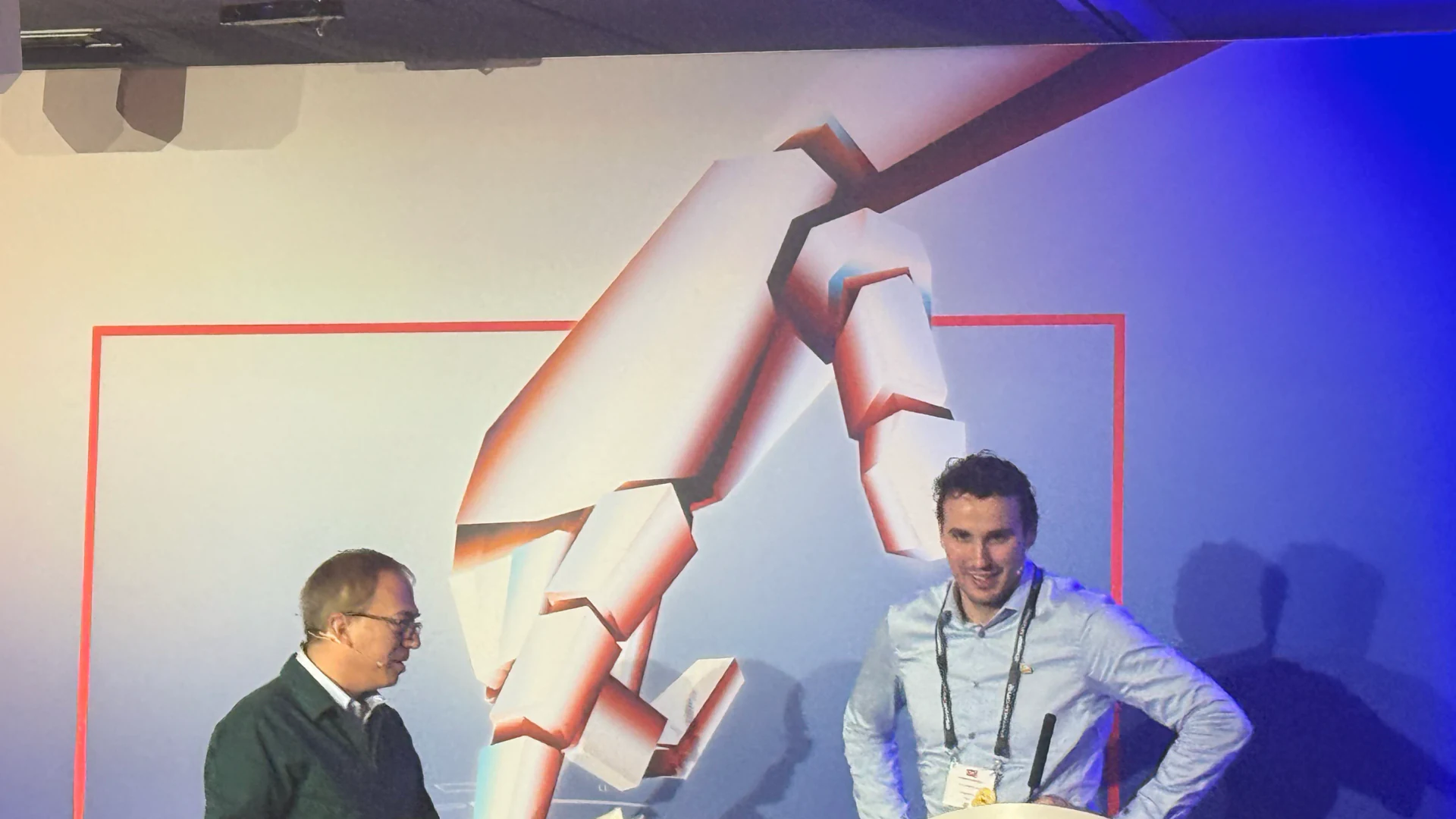
For six decades, industrial robotics has operated under an unforgiving paradigm: a human engineer explicitly programmes every millimetre of a machine's motion using proprietary languages, teach pendants, and rigid kinematic solvers. If a workpiece drifts by five millimetres or lighting conditions change, the robot faults. At the Economist Enterprise Physical AI and Robotics Summit in London on 13 October 2026, Pepijn Kooijmans, LeRobot lead at Hugging Face, presented an alternative architecture that is dismantling this legacy: "Future robots will not be programmed task by task. They will learn."
 .class="img-fluid clearfix"
From Motion Planning to Imitation Learning: The Architectural Shift #
Delivering his case study presentation, Open for business: how open source is accelerating physical AI, Pepijn Kooijmans traced his trajectory from classical mechatronics engineering into deep learning. For decades, roboticists were trained to decompose manipulation into discrete, isolated sub-problems: object segmentation, 6D pose estimation, coordinate frame transformations, trajectory planning with collision avoidance, and joint PID motor control.
While this analytical decomposition works well in rigidly fixtured automotive plants where parts arrive in micron-precise steel jigs, it collapses in brownfield industrial environments, laboratories, warehouses, and domestic settings. In the real world, objects deform, surfaces reflect light unpredictably, and human co-workers introduce dynamic obstacles.
The fundamental thesis presented by Hugging Face is that physical dexterity cannot be analytically specified through hand-coded rules; it must be acquired through experience. Just as large language models (LLMs) learned grammar, reasoning, and world knowledge by predicting the next token across massive text corpora, physical AI agents acquire motor skills by learning the distribution of actions conditioned on visual and sensory observations.
This transition from programming every motion to teaching through human demonstration marks the transition of robotics into its foundation model era.
Inside the Multi-Modal VLA Architecture #
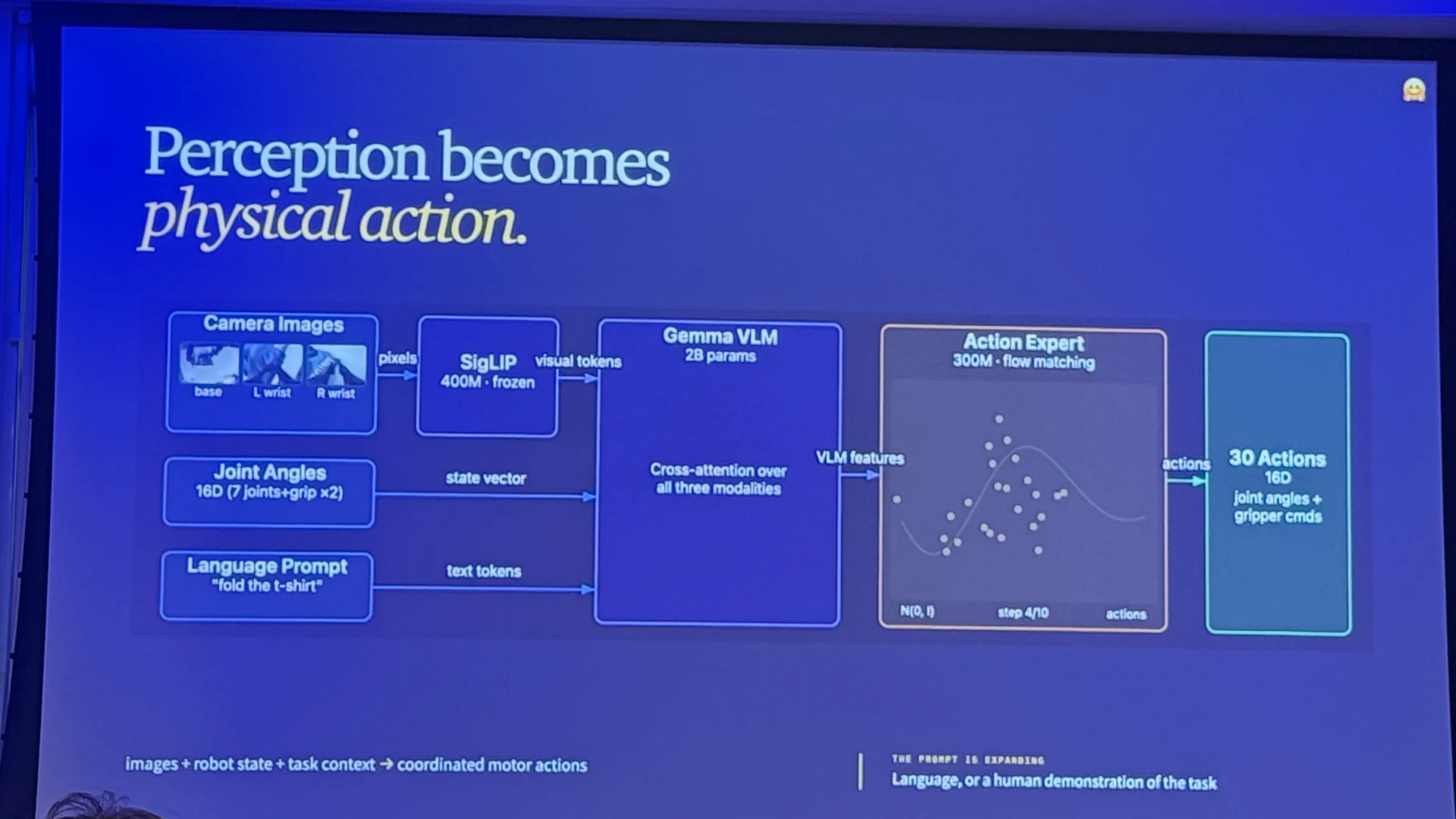
During his talk, Kooijmans revealed the detailed end-to-end neural network pipeline that powers modern open-source physical AI policies, illustrating how high-dimensional perceptual inputs are translated into fluid physical manipulation.
 .class="img-fluid clearfix"
The architecture operates as a tightly integrated multi-modal sensorimotor pipeline:
1. Perceptual Multi-Stream Ingestion #
The robot observes its workspace through multiple synchronized camera streams (typically an overhead base camera providing spatial context, alongside wrist-mounted cameras on the left and right manipulators for fine-grained contact tracking).
These raw pixel streams are passed into a frozen SigLIP (400M parameter) vision transformer, which converts the video frames into high-density visual tokens without requiring computationally prohibitive end-to-end gradient updates through the vision backbone during policy fine-tuning.
2. Kinematic State Vector and Task Conditioning #
Concurrently, the system samples the physical robot's internal proprioceptive state: a 16-dimensional vector capturing the 7 joint angles, velocities, and gripper opening widths of the dual manipulators.
The user provides the operational objective via an arbitrary natural language prompt (for example, "fold the t-shirt", "pick the M8 hex bolt and place it in the bracket", or "route the cable through the conduit"), which is tokenized into standard text embeddings.
3. Multi-Modal Cross-Attention Core (Gemma VLM) #
The visual tokens, proprioceptive state vector, and text tokens are injected into a Gemma Vision-Language Model (2B parameters). Rather than simply generating text tokens, the Gemma VLM performs deep cross-attention across all three modalities, fusing the high-level semantic intent of the language instruction with the spatial geometry of the visual scene and the instantaneous mechanical configuration of the arm.
The output of this fused foundation model is a dense representation of VLM task features that encapsulate what needs to be done in relation to where objects are situated.
4. The Action Expert: Flow Matching and Diffusion Policies #
The VLM features are fed directly into an Action Expert (300M parameters) operating on flow-matching principles. Unlike early imitation learning approaches that relied on naive mean squared error (MSE) regression (which causes models to output the average of conflicting demonstrations, leading to indecisive, frozen robots), flow matching models the multi-modal distribution of human action trajectories.
Using rectified flow differential equations solved across ten numerical integration steps, the Action Expert denoises Gaussian noise into a coherent trajectory of 30 future actions at a 50Hz control frequency.
5. Action Chunking with Temporal Ensembling #
By predicting 30 consecutive timesteps (an approach known as Action Chunking), the policy eliminates high-frequency jerking and latency bottlenecks. The robot executes the initial chunk of actions while computing the subsequent plan in the background, achieving smooth, compliant, and continuous biological-grade motion.
Technical Comparison: Classical Automation vs Open-Source Physical AI #
| Metric / Architectural Vector | Classical Industrial Robotics (ROS / PLC / Teach Pendant) | Proprietary Closed Physical AI (Vendor Humanoid Stacks) | Open-Source Physical AI (Hugging Face LeRobot Stack) |
|---|---|---|---|
| Development Paradigm | Procedural; explicit joint trajectories and finite state machines | End-to-end deep learning; black-box closed weights; locked cloud APIs | End-to-end VLA; open weights, open datasets, and open PyTorch training loops |
| Hardware Barrier to Entry | £30,000 to £100,000+ per industrial arm (KUKA, FANUC, ABB) | £150,000 to £350,000+ per proprietary humanoid unit | sub-$200 to $1,500 using 3D-printable open-hardware designs (SO-100, Koch) |
| Environmental Robustness | Fails immediately if part coordinates drift by millimetres | High adaptability, but behaviour cannot be inspected or locally patched | High visual adaptability; policies can be fine-tuned locally on shop-floor edge nodes |
| Data Format & Telemetry | Vendor-locked proprietary binary formats and PLC registers | Proprietary encrypted cloud telemetry | Standardized Apache Parquet datasets, MP4 video streams, and Hugging Face Hub |
| Task Generalization | Zero; every new component geometry requires complete manual reprogramming | Broad task claims, but slow adaptation to bespoke industrial tooling | Rapid adaptation via 50 to 100 human demonstrations recorded via leader-follower rigs |
| Inference Hardware Footprint | Dedicated PLC or industrial IPC running real-time Linux | Massive on-board mobile GPU clusters drawing 300W to 800W | Runs inference on consumer edge silicon (single RTX 4070 or Apple Silicon M-series) |
Source: Analysis of presentation data, technical benchmarks, and live demonstrations presented at the Economist Enterprise Physical AI and Robotics Summit (Convene 200 Aldersgate, London, 13 October 2026).
What This Means by Sector #
The rise of open, community-driven physical AI is altering the commercial calculus across multiple industries.
Small and Medium-Sized Enterprises (SMEs) #
SMEs represent over 80% of European and UK manufacturing capacity, yet historically fewer than 5% could afford automation. Deploying an industrial automation cell required hiring specialist systems integrators, paying six-figure software licensing fees, and freezing factory floors during installation.
With the LeRobot ecosystem, an SME manufacturing bespoke precision brackets can 3D-print a dual-arm SO-100 workstation for under £500, equip it with £40 USB webcams, and record fifty demonstrations of a worker loading parts into a CNC milling machine using a 3D-printed leader arm. Within three hours of fine-tuning on a standard desktop computer, the open-source policy is capable of running the machine tending task autonomously, achieving payback within weeks.
Academic Research and Higher Education #
Until recently, university robotics departments faced an existential divide: well-funded laboratories could afford Boston Dynamics or Willow Garage platforms, while smaller institutions were restricted to running pure simulations in Gazebo or MuJoCo.
Open-source physical AI has democratised physical experimentation. Graduate students globally can build identical hardware platforms, share trained policy checkpoints on the Hugging Face Hub, and reproduce benchmark results with statistical rigor. Kooijmans highlighted that the LeRobot repository grew from a handful of European contributors to thousands of active roboticists worldwide within months, proving that open access accelerates empirical validation faster than proprietary corporate silos.
High-Mix, Low-Volume Contract Assembly #
In electronics and medical device assembly, product variants change weekly. Hardcoded automation lines are economically unviable because the retooling and reprogramming costs exceed the production run's profit margin.
Vision-language-action policies resolve this constraint through natural language task conditioning. An operator can change the assembly procedure simply by typing a new command or demonstrating two iterations of the new sub-assembly. The model's cross-attention mechanisms leverage pre-trained visual representations to identify new components without retraining the entire neural network.
Breaking the Data Wall: Teleoperation, Parquet, and World Models #
The central insight Kooijmans delivered to enterprise leaders is that physical AI's primary bottleneck is no longer model capacity; it is demonstration diversity.
In natural language processing, models trained on trillions of tokens crawled from the open web. In physical robotics, there is no pre-existing "internet of physical manipulation". Every demonstration of a gripper picking an object, rotating a valve, or folding cloth must be recorded in the physical world through sensor-instrumented teleoperation.
Hugging Face LeRobot tackles this challenge through three core initiatives:
- Leader-Follower Teleoperation Rigs: By creating low-cost 3D-printed passive "leader" arms equipped with magnetic encoders that mechanically mirror the active "follower" robot, human operators can effortlessly teleoperate the robot in real time, recording joint angles, velocities, and multi-view video simultaneously.
- Standardized Parquet Dataset Schemas: Demonstrations are packaged into standardized, high-performance Apache Parquet tables mapped to chunked MP4 video feeds. This allows standard data engineering tools (Polars, DuckDB, PyArrow) to process terabytes of robotic telemetry at high speeds.
- Sim-to-Real and World Model Augmentation: To scale beyond physical teleoperation limits, open-source world models learn generative physical dynamics. Once trained on a core dataset of real-world demonstrations, world models simulate millions of counterfactual scenarios (varying lighting, introducing clutter, altering table friction) directly within latent space, stress-testing policies before real-world deployment.
Conclusion #
The presentation of Hugging Face LeRobot at the Economist Enterprise Physical AI and Robotics Summit crystallized a decisive inflection point in the robotics industry. The era when robotics required multimillion-pound capital budgets, proprietary programming languages, and rigid factory cages is giving way to an open, collaborative, and data-driven ecosystem.
By uniting multi-modal vision-language foundation models with flow-matching action chunking and affordable open hardware, open-source physical AI is transforming robots from brittle automata into adaptive, learning systems. For engineering leaders and technology executives, the strategic mandate is unequivocal: competitive advantage will no longer derive from owning proprietary mechanical hardware, but from mastering the data pipelines, demonstration collection workflows, and foundation models that teach machines to master the physical world.
Frequently Asked Questions #
What is Hugging Face LeRobot? Hugging Face LeRobot is an open-source framework and community initiative designed to democratise robotics and physical AI. It provides PyTorch-based implementations of state-of-the-art imitation learning algorithms, standardized dataset formats, pre-trained Vision-Language-Action (VLA) foundation models, and open-source hardware designs (such as the SO-100) to lower the financial and technical barriers to robotics.
How does imitation learning differ from classical robot programming? Classical robot programming requires an engineer to write explicit procedural code specifying exact Cartesian coordinates, inverse kinematic solutions, and state transitions using teach pendants or ROS scripts. Imitation learning, by contrast, trains neural networks to mimic human behavior by observing recorded demonstrations of humans performing the task via teleoperation, learning a policy that maps sensory observations directly to motor commands.
What is the role of the Gemma VLM in the physical AI pipeline? In modern physical AI architectures, the Gemma Vision-Language Model (VLM) serves as the multi-modal reasoning engine. It ingests visual tokens from cameras (encoded via SigLIP), the robot's physical joint state vector, and natural language instructions. Using cross-attention, it fuses semantic intent with visual geometry to produce high-level task representations that guide the action expert.
What is flow matching in robotics action prediction? Flow matching is a generative modeling technique related to continuous normalizing flows and diffusion models. In robotics, it transforms simple Gaussian noise into complex, multi-modal action trajectories by solving ordinary differential equations across multiple steps. This allows the robot to handle ambiguous situations where multiple valid movements exist, avoiding the averaging artifacts that cause simpler regression models to fail.
Can sub-$200 3D-printed robot arms perform production-level tasks? While sub-$200 arms like the SO-100 lack the payload capacity, structural rigidity, and sub-millimetre repeatability required for heavy aerospace machining, they are fully capable of executing delicate manipulation, inspection, laboratory liquid handling, and small parts kitting. More importantly, policies trained and validated on these low-cost platforms can be transferred directly to industrial-grade collaborative robot arms with minimal fine-tuning.
References #
- Economist Enterprise, (2026). Physical AI & Robotics Summit: Operational advantage through autonomous systems ⧉. Economist Enterprise.
- Kooijmans, P., (2026). Open for business: how open source is accelerating physical AI ⧉. Hugging Face.
- Hugging Face, (2026). LeRobot: State-of-the-art Machine Learning for Real-World Robotics in PyTorch ⧉. GitHub.
- Chi, C., Xu, Z., Feng, S., Cousineau, E., Du, Y., Burchfiel, B., & Song, S., (2024). Diffusion Policy: Visuomotor Policy Learning via Action Diffusion ⧉. Columbia University & MIT.
- Zhao, T. Z., Kumar, V., Levine, S., & Finn, C., (2023). Learning Fine-Grained Bimanual Manipulation with Low-Cost Hardware ⧉. Stanford University.
- Zhai, X., Mustafa, B., Kolesnikov, A., & Beyer, L., (2023). Sigmoid Loss for Language Image Pre-Training (SigLIP) ⧉. Google DeepMind.
- Lipman, Y., Chen, R. T. Q., Ben-Hamu, H., Nicklas, M., & Le, M., (2023). Flow Matching for Generative Modeling ⧉. Meta AI Research.
చివరిగా సమీక్షించబడింది .
చివరిగా సమీక్షించబడింది .
ఈ వ్యాసాన్ని క్రాస్-పోస్ట్ చేయండి
Medium కోసం ఫార్మాట్ చేసి కాపీ చేయండి
# Open-Source Physical AI: How Hugging Face LeRobot and End-to-End Imitation Learning Are Democratising Robotics — Sebastien Rousseau

> Originally published at [https://sebastienrousseau.com/te/2026-10-13-open-source-physical-ai-how-hugging/](https://sebastienrousseau.com/te/2026-10-13-open-source-physical-ai-how-hugging/)

At the Economist Enterprise Physical AI and Robotics Summit in London, Hugging Face LeRobot lead Pepijn Kooijmans unveiled the open-source architecture dismantling the barriers to physical AI. Explore how end-to-end imitation learning, Gemma vision-language models, flow-matching action experts, and $200 hardware are transforming robotics from rigid task programming into experiential learning.

Read the full article on sebastienrousseau.com: https://sebastienrousseau.com/te/2026-10-13-open-source-physical-ai-how-hugging/
Mastodon కోసం ఫార్మాట్ చేసి కాపీ చేయండి
Open-Source Physical AI: How Hugging Face LeRobot and End-to-End Imitation Learning Are Democratising Robotics — Sebastien Rousseau

At the Economist Enterprise Physical AI and Robotics Summit in London, Hugging Face LeRobot lead Pepijn Kooijmans unveiled the open-source architecture dismantling the barriers to physical AI. Explore how end-to-end imitation learning, Gemma vision-language models, flow-matching action experts, and…

https://sebastienrousseau.com/te/2026-10-13-open-source-physical-ai-how-hugging/
LinkedIn కోసం ఫార్మాట్ చేసి కాపీ చేయండి
Open-Source Physical AI: How Hugging Face LeRobot and End-to-End Imitation Learning Are Democratising Robotics — Sebastien Rousseau

At the Economist Enterprise Physical AI and Robotics Summit in London, Hugging Face LeRobot lead Pepijn Kooijmans unveiled the open-source architecture dismantling the barriers to physical AI.

ముఖ్యమైన వ్యూహాత్మక అంశాలు ఇవి:

- From Motion Planning to Imitation Learning: The Architectural Shift. Delivering his case study presentation, Open for business: how open source is accelerating physical AI, Pepijn Kooijmans traced his trajectory from classical mechatronics engineering into deep learning.
- Inside the Multi-Modal VLA Architecture. During his talk, Kooijmans revealed the detailed end-to-end neural network pipeline that powers modern open-source physical AI policies, illustrating how high-dimensional perceptual inputs are translated into fluid…
- Technical Comparison: Classical Automation vs Open-Source Physical AI. Source: Analysis of presentation data, technical benchmarks, and live demonstrations presented at the Economist Enterprise Physical AI and Robotics Summit (Convene 200 Aldersgate, London, 13 October 2026).
- What This Means by Sector. The rise of open, community-driven physical AI is altering the commercial calculus across multiple industries.

ఈ వ్యాసంలో వివరించిన సవాళ్లకు మీ సంస్థ దృక్పథం ఏమిటి?

→ https://sebastienrousseau.com/te/2026-10-13-open-source-physical-ai-how-hugging/

#HuggingFaceLerobot #PepijnKooijmans #PhysicalAi #OpenSourceRobotics #ImitationLearning

Sebastien Rousseau | CC-BY-4.0
ఈ వ్యాసాన్ని ఉదహరించండి
Open-Source Physical AI: How Hugging Face LeRobot and End-to-End Imitation Learning Are Democratising Robotics — Sebastien Rousseau
At the Economist Enterprise Physical AI and Robotics Summit in London, Hugging Face LeRobot lead Pepijn Kooijmans unveiled the open-source architecture dismantling the barriers to physical AI. Explore how end-to-end imitation learning, Gemma vision-language models, flow-matching action experts, and $200 hardware are transforming robotics from rigid task programming into experiential learning.
BibTeX
@online{rousseau2026open,
  author  = {Rousseau, Sebastien},
  title   = {{Open-Source Physical AI: How Hugging Face LeRobot and End-to-End Imitation Learning Are Democratising Robotics — Sebastien Rousseau}},
  year    = {2026},
  url     = {https://sebastienrousseau.com/te/2026-10-13-open-source-physical-ai-how-hugging/},
  urldate = {2026}
}RIS
TY  - GEN
AU  - Rousseau, Sebastien
TI  - Open-Source Physical AI: How Hugging Face LeRobot and End-to-End Imitation Learning Are Democratising Robotics — Sebastien Rousseau
PY  - 2026
UR  - https://sebastienrousseau.com/te/2026-10-13-open-source-physical-ai-how-hugging/
ER  -
Vancouver
Rousseau S. Open-Source Physical AI: How Hugging Face LeRobot and End-to-End Imitation Learning Are Democratising Robotics — Sebastien Rousseau. sebastienrousseau.com. 2026 Oct 13. Available from: https://sebastienrousseau.com/te/2026-10-13-open-source-physical-ai-how-hugging/
Chicago
Rousseau, Sebastien. "Open-Source Physical AI: How Hugging Face LeRobot and End-to-End Imitation Learning Are Democratising Robotics — Sebastien Rousseau." sebastienrousseau.com. October 13, 2026. https://sebastienrousseau.com/te/2026-10-13-open-source-physical-ai-how-hugging/.
APA
Rousseau, S. (2026, October 13). Open-Source Physical AI: How Hugging Face LeRobot and End-to-End Imitation Learning Are Democratising Robotics — Sebastien Rousseau. sebastienrousseau.com. https://sebastienrousseau.com/te/2026-10-13-open-source-physical-ai-how-hugging/
ఈ వ్యాసాన్ని పునఃప్రచురించండి
Open-Source Physical AI: How Hugging Face LeRobot and End-to-End Imitation Learning Are Democratising Robotics — Sebastien Rousseau
At the Economist Enterprise Physical AI and Robotics Summit in London, Hugging Face LeRobot lead Pepijn Kooijmans unveiled the open-source architecture dismantling the barriers to physical AI. Explore how end-to-end imitation learning, Gemma vision-language models, flow-matching action experts, and $200 hardware are transforming robotics from rigid task programming into experiential learning.
ఈ వ్యాసం కింది లైసెన్స్ కింద ఉంది Creative Commons Attribution 4.0 International. పునఃప్రచురణకు కానానికల్ URLకు ఆపాదన అవసరం.
Open-Source Physical AI: How Hugging Face LeRobot and End-to-End Imitation Learning Are Democratising Robotics — Sebastien Rousseau

At the Economist Enterprise Physical AI and Robotics Summit in London, Hugging Face LeRobot lead Pepijn Kooijmans unveiled the open-source architecture dismantling the barriers to physical AI. Explore how end-to-end imitation learning, Gemma vision-language models, flow-matching action experts, and $200 hardware are transforming robotics from rigid task programming into experiential learning.

Originally published at https://sebastienrousseau.com/te/2026-10-13-open-source-physical-ai-how-hugging/ by Sebastien Rousseau.
Licensed under CC-BY-4.0.