
Translation pending — read the English original while we localise.
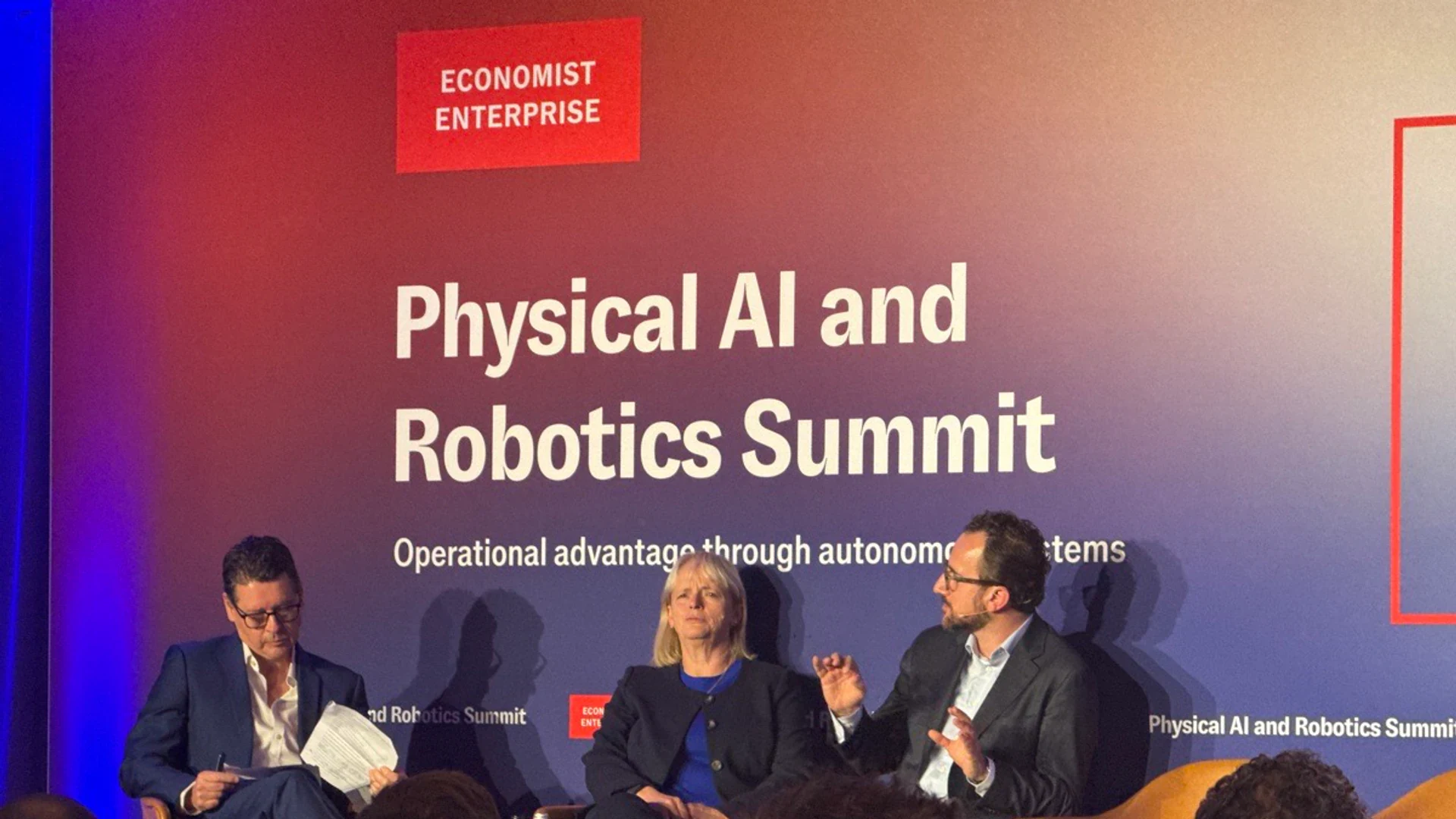
When enterprise software fails, it corrupts a database, drops a network connection, or leaks a token. When a physical AI system fails, hundreds of kilograms of articulated steel, high-torque hydraulic actuators, or autonomous earthmoving machinery collide with physical infrastructure or human bodies. At the Economist Enterprise Physical AI and Robotics Summit held at Convene 200 Aldersgate in London on 13 October 2026, a high-level panel gathered to address the urgent operational, ethical, and legal frontiers of industrial autonomy: how to maintain workforce trust, mitigate cognitive handover failures, and establish legally defensible liability frameworks as intelligent machines take the frontline.
 .class="img-fluid clearfix"
The Physical Embodiment Shock: Beyond Screen-Based Automation #
During the panel session, A meeting of minds (and machines): Humans, robots and the redesign of work, enterprise leaders examined the distinct psychological friction that emerges when artificial intelligence leaves the screen and enters the physical workspace.
Laura Bishop, AI & Cyber Security Digital Sector Lead at the British Standards Institution (BSI) and a specialist in occupational psychology, articulated the core challenge: when employees interact with large language models or desktop copilots, they maintain emotional detachment. The software exists inside a glass terminal; it can be minimized or turned off.
Physical AI, by contrast, occupies physical space. An autonomous excavator operating on a major highway project, a mobile collaborative robot arm picking crates alongside warehouse associates, or a robotic demolition rig moving through a confined commercial building shares the exact physical environment as the human workforce. When workers perceive a machine that possesses both physical power and autonomous decision-making capability, the psychological resistance intensifies. Workers experience what Bishop termed the "double threat": the existential fear of economic replacement coupled with immediate anxiety regarding physical safety.
Louisa Finlay, Chief Operating Officer of Kier Group (one of the United Kingdom's leading infrastructure, construction, and services groups), confirmed that successful technology adoption in heavy industry cannot be driven by top-down executive mandates. Frontline operatives in construction, earthworks, and infrastructure are intensely pragmatic. If a technology is perceived as a surveillance device, a safety risk, or a mechanism designed to cut headcount, workers will resist, bypass, or sabotage it.
Kier Group's approach centres on direct, visual, and transparent engagement. Finlay emphasised that leaders must be radically honest about organizational shifts. Administrative and manual tracking roles will shrink; however, machines can eliminate the tasks that cause long-term musculoskeletal injury, silicosis, and fatal industrial accidents.
The Handover Dilemma: Solving "Dark Side Autonomy" #
A major technical debate during the session focused on the severe safety vulnerabilities inherent in partial autonomy, an issue roboticists and human-factors engineers term "dark side autonomy".
In Level 2 and Level 3 autonomous systems (whether autonomous vehicles or collaborative industrial machines), the robot executes tasks independently under normal conditions, but requires a human operator to monitor the system and seize manual control whenever an anomaly arises.
Laura Bishop and systems deployer Roman cautioned that this supervisory model is dangerously flawed from a human-cognitive standpoint:
- Cognitive offloading and vigilance decay: Human brains are biologically incapable of maintaining active vigilance while passively observing a machine perform repetitive, error-free tasks for hours. Within twenty minutes, operator attention drifts, reaction times double, and eye tracking confirms cognitive disengagement.
- The situational awareness recovery gap: When an unexpected edge case occurs (such as an unmapped underground utility line encountered during robotic trenching, or a pedestrian stepping into a blind blind-spot), the autonomous system suddenly sounds an emergency alarm and hands control back to the operator. Studies show that re-acquiring complete visual-spatial situational awareness, understanding the failure mode, and executing an effective physical intervention requires five to fifteen seconds. In high-speed kinetic operations, that delay is fatal.
- The moral crumple zone: Relying on passive human oversight frequently serves as a corporate liability shield, transforming the human worker into a "moral crumple zone" who absorbs legal and criminal blame for an automated system's algorithmic failure simply because they held nominal override capability.
The consensus from the BSI and Kier Group is that industrial systems must transition toward monitored operational design domains (ODDs) with fail-operational or fail-safe stop envelopes. When an autonomous machine encounters an anomaly outside its certified boundaries, it must not execute an abrupt handover to an unprepared human; it must autonomously transition to a predictable, zero-energy safe state (such as setting brakes, lowering booms, and cutting hydraulic pressure) while requesting human review.
Framework Comparison: Operational Governance Models in Industrial Robotics #
| Governance Axis | Unregulated Early Adopter Model | Passive Supervisor ("Human as Backup") | Certified Shared Responsibility Framework (BSI / Kier Standard) |
|---|---|---|---|
| Workforce Communication | Opaque; automation introduced abruptly to cut immediate unit costs | Top-down compliance training; workers told to "watch the machine" | Transparent dialogue; workers involved in tool design, reskilling, and safety audits |
| Cognitive Handover Protocol | Sudden audible alarm requiring immediate human intervention | Expected manual override within 1 to 2 seconds of system fault | Bounded operational domains; automatic transition to fail-safe zero-energy stop |
| Liability Allocation | Undefined; buried in vendor standard disclaimers | Pushed downward onto the frontline operator or site supervisor | Three-tier contractual matrix (Model Provider, Systems Integrator, Site Deployer) |
| Regulatory Compliance | Minimal; basic machinery directive self-certification | Standard ISO 10218-1/2 industrial robot fencing | Full compliance with ISO/TS 15066, BSI PAS standards, and EU AI Act High-Risk mandates |
| Insurance Underwriting | High premiums; conditional coverage due to unmapped risks | Standard commercial liability with severe subrogation clauses | Tailored risk underwriting based on audited telemetry and runtime telemetry logs |
| Worker Role Definition | Displaced labour or low-wage machine tender | High-stress passive monitor prone to cognitive fatigue | Certified fleet supervisor, teleoperation manager, and digital logistics lead |
Source: Synthesis of panel contributions, occupational psychology research, and infrastructure risk governance standards presented at the Economist Enterprise Physical AI and Robotics Summit (Convene 200 Aldersgate, London, 13 October 2026).
What This Means by Sector #
The operational, safety, and legal redesign of work is being enacted differently across physical industry verticals.
Heavy Construction and Infrastructure #
In civil infrastructure, workforce shortages, aging demographics, and extreme safety risks create an urgent need for automation. Construction remains one of the most hazardous industries globally, responsible for thousands of severe injuries and fatalities annually from falls from height, structural collapses, and heavy plant strikes.
Louisa Finlay outlined how Kier Group is redesigning frontline operations by automating dangerous physical toil. Autonomous robotic pile-driving, automated compaction rollers, and drone-based volumetric surveying remove human workers from hazardous trench edges and active haul roads.
Crucially, the plant operators who previously spent eight hours in vibrating diesel cabs exposed to dust and noise are being retrained as digital site managers. Operating from air-conditioned site control cabins or remote operations centres, these workers oversee multiple semi-autonomous machines simultaneously, using high-definition video feeds and digital twin telemetry. Workforce satisfaction increases because physical fatigue and injury risks decline while compensation aligns with higher technical skill levels.
Public Utilities and Civil Maintenance #
In water treatment, nuclear decommissioning, and electrical grid maintenance, workers face toxic, high-radiation, or high-voltage environments. Autonomous inspection crawlers and aerial drones are replacing human entry into confined sewers and sub-stations.
Governance in this sector focuses heavily on cyber-physical integrity. As Laura Bishop noted, physical AI systems represent connected IoT endpoints with kinetic actuators. If an autonomous chemical dosing robot or pipeline valve manipulator suffers a cybersecurity breach, the consequence is not data theft; it is physical environmental contamination. Operational governance requires immutable, cryptographically signed audit logs and physical hardware air-gaps on safety-critical cutoffs.
Logistics and Fulfilment Networks #
E-commerce fulfillment centres have been the primary proving ground for collaborative autonomous mobile robots (AMRs). However, early implementations that treated workers as high-speed pickers paced by robotic conveyor algorithms led to extreme turnover and union friction.
Modern logistics governance prioritizes ergonomic collaboration. Autonomous carts carry heavy totes between picking aisles, allowing human workers to remain in ergonomically optimized picking zones where they perform tactile inspection and item sorting. System metrics are shifting from punitive per-minute pick quotas to overall team fulfillment accuracy, establishing a culture of mutual reliance between human and machine.
Contract Engineering: Structuring Multi-Tiered Liability #
Who is legally accountable when an autonomous robot causes physical damage or injury? The panel addressed this question directly, rejecting the simplistic notion that liability can rest on a single party.
In modern physical AI, autonomous systems are complex assemblies comprising base foundation models, specialized fine-tuning, commercial sensors, mechanical chasses, and site-level integration.
Enterprise deployers are establishing three-tiered risk allocation contracts:
Tier 1: Foundation Model and OEM Hardware Suppliers #
The original equipment manufacturer (OEM) and foundation model developer carry liability for intrinsic algorithmic defects, hardware mechanical failures, and violations of pre-trained safety envelopes. If a model exhibits hallucinations that bypass core safety limits under inputs within its certified specification, the liability rests with the supplier.
Tier 2: Systems Integrators and Domain Deployers #
The systems integrator responsible for fine-tuning the model on domain-specific datasets, calibrating camera and LiDAR arrays, and programming local boundary logic carries liability for integration defects. Integrator contracts must explicitly define the Environmental Operational Design Domain (ODD), specifying acceptable lighting, weather, dust levels, and floor gradient parameters.
Tier 3: Operating Enterprises and Site Owners #
The enterprise deploying the robot on site maintains responsibility for environmental compliance, physical workspace maintenance, and workforce training. If a site manager allows unauthorized personnel into an active robotic operating zone, disables physical safety geofences, or fails to maintain mandated calibration schedules, liability remains with the site operator.
By codifying these boundaries into commercial contracts and aligning them with insurer underwriting requirements, enterprises can deploy physical AI with clear legal certainty rather than waiting for courtroom precedents following an industrial catastrophe.
Conclusion #
The insights shared by Louisa Finlay, Laura Bishop, and their fellow panelists at the Economist Enterprise Physical AI and Robotics Summit made one reality unmistakably clear: the greatest barrier to scaling physical AI across enterprise operations is not the sophistication of neural networks or the power density of brushless actuators; it is human governance.
Robots operate in the physical world, alongside human beings whose livelihoods, dignity, and bodily safety are inextricably tied to their work environments. Any enterprise leadership team that approaches physical AI purely as a financial exercise in labour cost elimination will encounter fierce cultural resistance, severe handover safety failures, and crippling regulatory liabilities.
Real operational advantage belongs to organizations that treat physical AI as a catalyst for the profound redesign of work. By eliminating dangerous toil, respecting cognitive limitations during human-machine interaction, and engineering clear contractual lines of accountability, forward-thinking enterprises can build a future where intelligent machines and empowered human workers collaborate to build safer, more resilient industries.
Frequently Asked Questions #
Why does physical AI trigger more workforce anxiety than software-based AI? Unlike software automation (such as chatbots or predictive analytics) which exists solely on screens, physical AI operates in the physical world, wielding kinetic energy, mass, and speed. Workers experience a heightened "double threat": the existential fear of economic job replacement combined with visceral anxiety regarding their physical safety in a shared workspace.
What is "dark side autonomy" in robotics? "Dark side autonomy" refers to the cognitive failure that occurs when human operators are assigned to passively monitor semi-autonomous systems as safety backups. Humans are biologically incapable of maintaining vigilance during prolonged periods of passive monitoring. When an edge-case failure occurs, operators suffer from a severe situational awareness deficit and cannot intervene quickly enough to prevent an accident.
How is Kier Group approaching the adoption of physical AI in construction? Kier Group focuses on transparent, visual engagement with frontline workforces. Rather than positioning robotics as a headcount reduction tool, Kier frames automation as a way to eliminate dangerous, physically debilitating toil - such as trench excavation, working at height, and heavy lifting. Operatives are retrained into supervisory roles, operating multiple semi-autonomous machines remotely from safe, controlled environments.
How should contractual liability be divided in autonomous robotics accidents? Liability should be distributed across three tiers based on decision-making control: Foundation Model and OEM suppliers are liable for algorithmic failures within certified parameters; Systems Integrators are accountable for site-specific calibration, sensor mounting, and domain adaptation; and Site Deployers are responsible for maintaining workspace geofencing, environmental safety, and operator training.
What standards govern the safe deployment of collaborative industrial robots? The primary standards include ISO 10218-1 and ISO 10218-2 (safety requirements for industrial robots and systems integration), ISO/TS 15066 (specific safety requirements for collaborative robot operations and human-robot contact force limits), emerging British Standards Institution (BSI) guidance on autonomous systems governance, and the EU AI Act High-Risk Machinery conformity requirements.
References #
- Economist Enterprise, (2026). Physical AI & Robotics Summit: Operational advantage through autonomous systems ⧉. Economist Enterprise.
- Finlay, L., (2026). A meeting of minds (and machines): Humans, robots and the redesign of work ⧉. Kier Group.
- Bishop, L., (2026). Human Factors, Psychological Safety, and Governance in Autonomous Systems ⧉. British Standards Institution (BSI).
- British Standards Institution, (2025). BSI PAS 2025: Governance and ethical deployment of autonomous mobile systems in industrial environments ⧉. BSI.
- European Parliament and Council, (2024). Regulation (EU) 2024/1689 laying down harmonised rules on artificial intelligence (Artificial Intelligence Act) ⧉. Official Journal of the European Union.
- Bainbridge, L., (1983). Ironies of Automation ⧉. Automatica, 19(6), 775-779.
- International Organization for Standardization, (2026). ISO/TS 15066:2026 Robots and robotic devices - Collaborative robots ⧉. ISO.
Bita ta ƙarshe .
Bita ta ƙarshe .
Sake buga wannan labarin
Kwafa tsarin Medium
# Physical AI and Workforce Governance: Trust, Liability, and the Redesign of Frontline Operations — Sebastien Rousseau

> Originally published at [https://sebastienrousseau.com/ha/2026-10-13-physical-ai-and-workforce-governance-trust/](https://sebastienrousseau.com/ha/2026-10-13-physical-ai-and-workforce-governance-trust/)

At the Economist Enterprise Physical AI and Robotics Summit in London, industrial leaders from Kier Group and the British Standards Institution (BSI) addressed the urgent governance challenges of autonomous systems. Examine how to navigate workforce trust, mitigate 'dark side autonomy' during human-machine handovers, and allocate operational liability across construction, infrastructure, and heavy industry.

Read the full article on sebastienrousseau.com: https://sebastienrousseau.com/ha/2026-10-13-physical-ai-and-workforce-governance-trust/
Kwafa tsarin Mastodon
Physical AI and Workforce Governance: Trust, Liability, and the Redesign of Frontline Operations — Sebastien Rousseau

At the Economist Enterprise Physical AI and Robotics Summit in London, industrial leaders from Kier Group and the British Standards Institution (BSI) addressed the urgent governance challenges of autonomous systems. Examine how to navigate workforce trust, mitigate 'dark side autonomy' during human-…

https://sebastienrousseau.com/ha/2026-10-13-physical-ai-and-workforce-governance-trust/
Kwafa an tsara don LinkedIn
Physical AI and Workforce Governance: Trust, Liability, and the Redesign of Frontline Operations — Sebastien Rousseau

At the Economist Enterprise Physical AI and Robotics Summit in London, industrial leaders from Kier Group and the British Standards Institution (BSI) addressed the urgent governance challenges of autonomous systems.

Ga abubuwan da ya kamata a lura da su na dabarun:

- The Physical Embodiment Shock: Beyond Screen-Based Automation. During the panel session, A meeting of minds (and machines): Humans, robots and the redesign of work, enterprise leaders examined the distinct psychological friction that emerges when artificial intelligence leaves…
- The Handover Dilemma: Solving "Dark Side Autonomy". A major technical debate during the session focused on the severe safety vulnerabilities inherent in partial autonomy, an issue roboticists and human-factors engineers term "dark side autonomy".
- Framework Comparison: Operational Governance Models in Industrial Robotics. Source: Synthesis of panel contributions, occupational psychology research, and infrastructure risk governance standards presented at the Economist Enterprise Physical AI and Robotics Summit (Convene 200 Aldersgate,…
- What This Means by Sector. The operational, safety, and legal redesign of work is being enacted differently across physical industry verticals.

Menene hanyar ƙungiyar ku wajen magance ƙalubalen da aka kawo a wannan rubuce-rubucen?

→ https://sebastienrousseau.com/ha/2026-10-13-physical-ai-and-workforce-governance-trust/

#PhysicalAi #WorkforceGovernance #LouisaFinlay #KierGroup #LauraBishop

Sebastien Rousseau | CC-BY-4.0
Buga wannan labari
Physical AI and Workforce Governance: Trust, Liability, and the Redesign of Frontline Operations — Sebastien Rousseau
At the Economist Enterprise Physical AI and Robotics Summit in London, industrial leaders from Kier Group and the British Standards Institution (BSI) addressed the urgent governance challenges of autonomous systems. Examine how to navigate workforce trust, mitigate 'dark side autonomy' during human-machine handovers, and allocate operational liability across construction, infrastructure, and heavy industry.
BibTeX
@online{rousseau2026physical,
  author  = {Rousseau, Sebastien},
  title   = {{Physical AI and Workforce Governance: Trust, Liability, and the Redesign of Frontline Operations — Sebastien Rousseau}},
  year    = {2026},
  url     = {https://sebastienrousseau.com/ha/2026-10-13-physical-ai-and-workforce-governance-trust/},
  urldate = {2026}
}RIS
TY  - GEN
AU  - Rousseau, Sebastien
TI  - Physical AI and Workforce Governance: Trust, Liability, and the Redesign of Frontline Operations — Sebastien Rousseau
PY  - 2026
UR  - https://sebastienrousseau.com/ha/2026-10-13-physical-ai-and-workforce-governance-trust/
ER  -
Vancouver
Rousseau S. Physical AI and Workforce Governance: Trust, Liability, and the Redesign of Frontline Operations — Sebastien Rousseau. sebastienrousseau.com. 2026 Oct 13. Available from: https://sebastienrousseau.com/ha/2026-10-13-physical-ai-and-workforce-governance-trust/
Chicago
Rousseau, Sebastien. "Physical AI and Workforce Governance: Trust, Liability, and the Redesign of Frontline Operations — Sebastien Rousseau." sebastienrousseau.com. October 13, 2026. https://sebastienrousseau.com/ha/2026-10-13-physical-ai-and-workforce-governance-trust/.
APA
Rousseau, S. (2026, October 13). Physical AI and Workforce Governance: Trust, Liability, and the Redesign of Frontline Operations — Sebastien Rousseau. sebastienrousseau.com. https://sebastienrousseau.com/ha/2026-10-13-physical-ai-and-workforce-governance-trust/
Sake buga wannan labari
Physical AI and Workforce Governance: Trust, Liability, and the Redesign of Frontline Operations — Sebastien Rousseau
At the Economist Enterprise Physical AI and Robotics Summit in London, industrial leaders from Kier Group and the British Standards Institution (BSI) addressed the urgent governance challenges of autonomous systems. Examine how to navigate workforce trust, mitigate 'dark side autonomy' during human-machine handovers, and allocate operational liability across construction, infrastructure, and heavy industry.
An lasisin wannan labari a karkashin Creative Commons Attribution 4.0 International. Sake bugawa na bukatar nuna asalin URL na asali.
Physical AI and Workforce Governance: Trust, Liability, and the Redesign of Frontline Operations — Sebastien Rousseau

At the Economist Enterprise Physical AI and Robotics Summit in London, industrial leaders from Kier Group and the British Standards Institution (BSI) addressed the urgent governance challenges of autonomous systems. Examine how to navigate workforce trust, mitigate 'dark side autonomy' during human-machine handovers, and allocate operational liability across construction, infrastructure, and heavy industry.

Originally published at https://sebastienrousseau.com/ha/2026-10-13-physical-ai-and-workforce-governance-trust/ by Sebastien Rousseau.
Licensed under CC-BY-4.0.